
Ahikāroa coordinates access to mental health residential recovery services across the Waikato region.
We work with a variety of residential recovery providers, including kaupapa Māori services. Our aim is to match tāngata whai ora to a service that best suits their needs.
Access 20 different residential recovery services
Residential providers we work with vary based on location, whether the accommodation is individual or shared, how much staff support is available, and the goals of the tāngata whai ora living there. They are arranged by level (3, 3+ and 4), with some services able to cater to multiple levels of support.
Note: The length of time it takes for someone to be offered a place at a residential service will vary, as it depend on the availability of a suitable vacancy and the person’s individual needs.
Placement options
How residential recovery services work
A mental health residential recovery service aims to promote recovery and wellbeing of tāngata whai ora. These services are based in residential settings where tāngata whai ora stay on site with staff support. A stay at a mental health residential recovery service is planned and time-limited.
Accommodation and staffing
Depending on the type of residential service, residents may share a house or have a separate unit in a group of units. Staffing levels vary in each site, depending on what level of support is needed. Some services have staff available during the day only, others will have staff onsite 24 hours a day. There are residential recovery service options across the Waikato region, including kaupapa Māori services.
Goal setting and support
During a stay at a mental health residential recovery service, tāngata whai ora will set goals and be supported to achieve these by residential provider staff, their clinical team, whānau, and any other supports they have in place. Residential recovery services are about supporting people towards living independently, moving into their own home and living well in the community. How long people stay will depend on their needs.
Many residential services run programmes or encourage activities to help improve well-being and work towards goals. These may be centred around developing skills and strategies for making meals, looking after your home, shopping, budgeting, managing your health, medication support, reconnecting with whānau, engaging with cultural practices and community involvement.
Cost
These services are provided at a cost to tāngata whai ora in the form of a weekly payment, much like paying rent. The exact cost can be discussed with the individual residential provider, as the costs vary between services.
Ahikāroa’s co-ordination role
Ahikāroa provides coordination of referrals and funding, tracks vacancies and leads communication across the sector, and ensures regular reviews take place to ensure support needs are being met and barriers reduced.
-
- The Ahikāroa coordination team receives and reviews referrals for residential placements, working in partnership with clinical teams and residential providers to identify suitable placements at the services we work with, and coordinate access to current or upcoming vacancies.
- We complete the relevant documentation to fund the placement once the tangata whai ora has entered a residential service, and send this to the Ministry of Health (MOH) or Waikato DHB Strategy & Funding.
- We communicate any placement changes to MOH.
-
- Ahikāroa tracks all of the current and upcoming vacancies across the 20 residential services we co-ordinate access to.
- We chair and lead the weekly occupancy and flow meetings, to support communication and collaboration across the sector.
- Our teams work with relevant stakeholders to identify and overcome any barriers tāngata whai ora face when accessing supported residential services and transitions.
-
- Ahikāroa meets regularly with residential providers to review how a placement is going, and to ensure it is meeting the needs of tāngata whai ora.
- We identify any issues or challenges that arise, including when someone may be at risk of losing a placement, and collaborate with relevant stakeholders to determine ongoing support needs and help tāngata whai ora sustain and progress their living situation.
- We identify who may be ready to transition into independent housing in the community. We can then connect with the Ahikāroa housing team to support this transition.
Ahikāroa dashboard
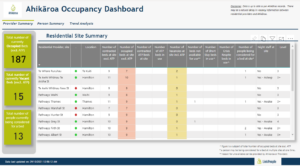
The Ahikāroa dashboard shows the number of vacancies available across the different residential recovery services we coordinate access to. It also shows who has been referred to a particular residential provider, when they were referred, and can provide a list of the other residents staying at the residential service.
To access the dashboard, a licence is required. Team leaders at the Waikato DHB, and residential recovery providers have a licence to access to the dashboard.
If you would like to discuss the dashboard further, please email Ahikaroa @wisegroup.co.nz. For technical support with the dashboard please contact Laura Sears: laura.sears@linkpeople.co.nz

Ahikāroa is part of the Wise Group. Copyright ©2026